How to sue your landlord for a security deposit in New Jersey
Find your court and forms, check the fees, and organize the evidence for your deposit claim.
- Court
- Small Claims Section, Special Civil Part (Superior Court)
- Claim limit
- $5,000
- Filing fee
- $35 for small claims, $50-$75 above $5,000Plus $10 for service by mail per defendant
- Start here
- Check the court, forms, and any required notice before filing.Court instructions →
Lawyer, costs and possible recovery
- Lawyer needed
- No - built for self-representation. Check the local rules on attorney participation.
- Attorney's fees if you win
- May be awarded if the statute's conditions are met
- What a judgment can include
- 2x withheld (mandatory) + attorney's fees
Analysis free · case documents $49, one time · mailing optional
First: New Jersey's statute doesn't cover every tenancy - check the note below before you file.
Where are you in the process?
All sections in this guide
Not sure a lawsuit is the next step? Start with the New Jersey playbook · free demand letter template
Start with the right court and forms
Use the small claims complaint kit for a security-deposit claim of $5,000 or less. Claims above $5,000 and up to $20,000 use the Special Civil Part process. The court guide links filing instructions, forms, and JEDS online submission.
New Jersey small claims forms and instructions ↗Up to $5,000 use the Small Claims kit CN 10151 - its complaint form names security deposits as a case type. Above $5,000 use the Special Civil Part complaint CN 10541. Both are free to download from njcourts.gov and free at the clerk's window.
JEDS takes the complaint around the clock and processes it the next business day: desktop only, PDF, DOCX or JPG under 35 MB, paid by card, and everything must go in one submission - nothing can be added later. Evidence for the hearing goes through the separate Evidence Submission system.
NJ filing fees and fee-waiver instructions ↗Linked procedure notes checked 2026-09-07. Check the current court instructions when filing.
Start with the amount you dispute
Enter your deposit and refund. Add any deductions you accept, then continue to a free analysis of your charges.
Enter 0 if nothing was returned. Accepted deductions are optional.
Accepting deductions reduces the refund you dispute. It does not waive separate statutory remedies or confirm that the landlord provided a complete statement.
Additional damages and court costs (optional)
Additional damages are an extra amount, not a total multiplier that already includes the refund. Use the New Jersey remedy rules to avoid counting the deposit twice. Court fees are listed separately; check which amounts your court includes in its limit.
Enter the deposit and amount returned, using non-negative dollar amounts with at most two decimal places.
See a sample calculation
Example only: $1,200 paid, $300 returned, and $100 in deductions accepted leaves $800 disputed. With no additional damages requested, the claim is $800. Example $35 filing and $10 service costs are recorded separately. These are illustrative amounts, not a fee quote. Check the current New Jersey court fee schedule.
Build your timeline (optional)
Record what happened, when, and the exhibit that supports it. Leave events that have not happened blank.
Before you submit: preparation checklist
Download or save your worksheet before leaving this page. Continuing copies these notes into your case. Use the official court forms to file.
New Jersey: security deposit court preparation
Working figures and preparation notes. File using the official court forms.
| Security deposit court preparation worksheet | New Jersey | |
| Working figures only. Use official court forms to file. | ||
| Deposit paid | ||
| Returned | ||
| Deductions accepted | ||
| Additional damages requested | ||
| Legal basis and conditions | ||
| Filing costs | ||
| Service costs | ||
| Applicable court limit | $5,000 | |
| Selected court limit | 5000 | |
| Event | Date | Evidence / notes |
| Deposit paid | ||
| Move-in condition recorded | ||
| Moved out / keys returned | ||
| Refund or deductions received | ||
| Demand or required notice delivered | ||
| Claim served | ||
| Hearing | ||
| Preparation checklist | Status | |
| Confirm the correct court, venue, and claim limit. | To do | |
| Check the filing deadline and any required demand, notice, or cure period. | To do | |
| Confirm each defendant’s legal name and an address where service is permitted. | To do | |
| Explain every disputed deduction and any additional damages separately. | To do | |
| Gather the lease, payment records, deductions, photos, correspondence, and proof of notice. | To do | |
| Use the current court forms; check filing costs and fee-waiver options. | To do | |
| Arrange proper service and file proof by the required deadline. | To do | |
| Check hearing, evidence-exchange, remote attendance, and mediation instructions. | To do |
Your deposit evidence, in one place
Who owes the money
The lease and deposit payment record, with the responsible landlord's legal name and service address. Identify the company separately from its registered agent.
What happened and when
Move-out and key-return records, the deduction statement if received, your written demand and delivery evidence, and the landlord's response.
Why you dispute each charge
Match each deduction to dated photos, messages or receipts. Show the deposit, refunds and accepted deductions separately from additional damages and court costs.
Inside a sample case
Your charges. A clear argument. A prepared demand.
- Free analysis
- Check your disputed charges and the deposit rules that apply to your case.
- Case documents
$49, one time - Your demand letter, charge-by-charge analysis, damages summary, and evidence checklist in one case PDF.
- Your filing steps
- You review the documents, attach your actual evidence, and file using your court's official forms. Court fees and optional mailing are separate.
See the actual PDF pages
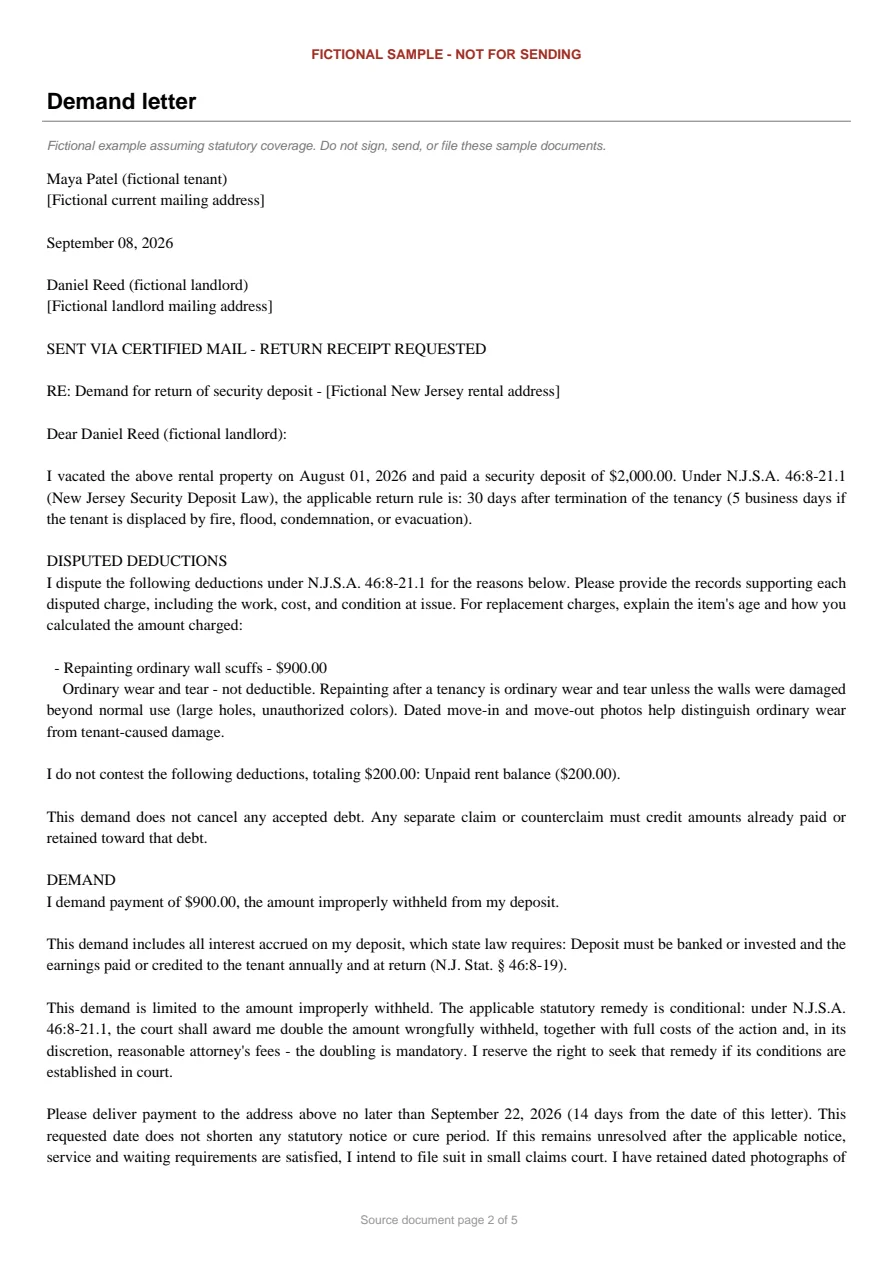
Open PDF to zoom ↗Sample New Jersey case. Letter and exhibit pages extracted from a generated case PDF. Filing instructions are in this guide.
Turn disputed charges into a clear argument, a damages summary, and an exhibit checklist.
Analysis free · case documents $49, one time · mailing optional
See this sample's charges and calculation
Generated sample · New Jersey case
2026-09-0801 / The disputed charge
Repainting ordinary wall scuffs$900
Ordinary wear and tear - not deductible
Supporting evidence: move-in photos and move-out photos.
N.J.S.A. 46:8-21.1 ↗02 / The calculation
- Deposit paid
- $2,000
- Already returned
- $900
- Accepted deductions
- $200
- Demanded back
- $900
No additional damages in this example. Your facts and New Jersey law determine your analysis.
03 / From the generated demand letter
I demand payment of $900.00, the amount improperly withheld from my deposit.
A landlord may still pursue an unpaid accepted charge in a separate claim or counterclaim, so net recovery can be lower. Money already paid or retained toward that charge must be credited. The $200 rent balance retained in this sample is already excluded from the demand.
Read the full New Jersey sample and evidence checklist
Fictional sample assuming the tenancy is covered by the cited law. Demonstrates generated documents, not a court outcome.
Maya Patel (fictional tenant)
[Fictional current mailing address]

September 08, 2026

Daniel Reed (fictional landlord)
[Fictional landlord mailing address]

SENT VIA CERTIFIED MAIL - RETURN RECEIPT REQUESTED

RE: Demand for return of security deposit - [Fictional New Jersey rental address]

Dear Daniel Reed (fictional landlord):

I vacated the above rental property on August 01, 2026 and paid a security deposit of $2,000.00. Under N.J.S.A. 46:8-21.1 (New Jersey Security Deposit Law), the applicable return rule is: 30 days after termination of the tenancy (5 business days if the tenant is displaced by fire, flood, condemnation, or evacuation).

DISPUTED DEDUCTIONS
I dispute the following deductions under N.J.S.A. 46:8-21.1 for the reasons below. Please provide the records supporting each disputed charge, including the work, cost, and condition at issue. For replacement charges, explain the item's age and how you calculated the amount charged:

  • Repainting ordinary wall scuffs - $900.00
    Ordinary wear and tear - not deductible. Repainting after a tenancy is ordinary wear and tear unless the walls were damaged beyond normal use (large holes, unauthorized colors). Dated move-in and move-out photos help distinguish ordinary wear from tenant-caused damage.

I do not contest the following deductions, totaling $200.00: Unpaid rent balance ($200.00).

This demand does not cancel any accepted debt. Any separate claim or counterclaim must credit amounts already paid or retained toward that debt.

DEMAND
I demand payment of $900.00, the amount improperly withheld from my deposit.

This demand includes all interest accrued on my deposit, which state law requires: Deposit must be banked or invested and the earnings paid or credited to the tenant annually and at return (N.J. Stat. § 46:8-19).

This demand is limited to the amount improperly withheld. The applicable statutory remedy is conditional: under N.J.S.A. 46:8-21.1, the court shall award me double the amount wrongfully withheld, together with full costs of the action and, in its discretion, reasonable attorney's fees - the doubling is mandatory. I reserve the right to seek that remedy if its conditions are established in court.

Please deliver payment to the address above no later than September 22, 2026 (14 days from the date of this letter). This requested date does not shorten any statutory notice or cure period. If this remains unresolved after the applicable notice, service and waiting requirements are satisfied, I intend to file suit in small claims court. I have retained dated photographs of the property's condition, the lease, our correspondence, your itemized statement, the repair receipts you provided, and this demand letter.

Sincerely,


Maya Patel (fictional tenant)

Enclosures: Evidence exhibit list
Charge-by-charge analysis
Repainting ordinary wall scuffs: $900
Ordinary wear and tear - not deductible
Evidence: move-in photos and move-out photos. Source: N.J.S.A. 46:8-21.1.
Evidence checklist
Exhibit 1: Signed lease agreement
Establishes deposit amount and terms
Exhibit 2: Timestamped move-in photos/video
Baseline condition at the start of tenancy
Exhibit 3: Timestamped move-out photos/video
Condition at surrender - rebuts damage claims
Exhibit 4: Landlord's itemized statement
Shows the charges being disputed and its date
Exhibit 5: Correspondence with landlord
Timeline, forwarding address, admissions
Exhibit 6: Demand letter + certified mail receipt
Proof of formal demand and date
Exhibit 7: Charge-by-charge legal analysis
Shows each deduction is improper, unsupported, or wear and tear, with statute citations - included as a formatted exhibit in the case PDF
Filing, judgment and collection
Who you name as defendant
New Jersey's Landlord Identity Law makes every landlord file a registration statement naming the owner and, where the owner is a company, an agent who can be served - with the municipal clerk for one- and two-unit buildings, and with the Department of Community Affairs for anything larger. The clerk's copy is a public record. Ask for it before you file: the name on the lease is often a management office that has since moved, and a judgment entered against the wrong name cannot be collected.
File in small claims court
Use the New Jersey filing instructions above. Keep your filed copies and confirmation.
Service and proof
The clerk sends the summons and complaint by ordinary and certified mail. Service by mail costs $10 per defendant, separate from the filing fee, effective May 1, 2025. If mail service fails, follow the court instructions for re-service.
Service by mail costs $10 per defendant, in addition to filing. For one defendant in small claims, budget $35 filing plus $10 mail service, or $45 initially. If service fails, follow the court’s re-service instructions.
NJ notice: mail service fee effective May 1, 2025 ↗Build the exhibit stack
Number the records in the evidence checklist. Prepare a one-page calculation with an exhibit supporting each disputed charge. Follow your court's copy and upload instructions.
How your case is decided
Follow the hearing notice for attendance, witnesses and evidence submission. Explain the amount you seek, then show the records supporting each disputed charge.
Turn disputed charges into a clear argument, a damages summary, and an exhibit checklist.
Analysis free · case documents $49, one time · mailing optional
Won your case? Take the next step toward getting paid
Get the written judgment and request payment. If unpaid, use the court's enforcement instructions and check fees, timing and exemptions. Winning does not guarantee collection.
Is it worth suing? The fee math
Budget $35 for small claims, $50-$75 above $5,000, plus $10 for service by mail per defendant. Ask for eligible court costs and keep the receipts; reimbursement depends on the court's award.
Court limit: $5,000. Depending on the facts, you can request double the amount wrongfully withheld - the doubling is mandatory, plus eligible court costs (N.J.S.A. 46:8-21.1).
If your claim is bigger. Above $5,000 the claim is not turned away - it moves to the Special Civil Part of the same court, which hears up to $20,000. Same courthouse, longer form (CN 10541) and a $50-$75 fee instead of $35. Past $20,000 it belongs in the Law Division, and at that size it is worth an hour of a lawyer's time first.
Check the conditions for additional damages in the New Jersey deposit-law guide. Lawyer and fee-recovery questions are covered in the FAQ below.
Run your numbers - free
Enter your move-out date and deposit to check the return period and see the potential remedies under N.J.S.A. 46:8-21.1. Then use the worksheet to calculate the amount you dispute. This checks the refund period, not the deadline for filing a lawsuit.
Before you file: put your demand in writing
Mailing your own demand letter
$7-11
Estimated USPS postage with a return receipt for a letter you prepare yourself. Case documents and optional mailing service are priced separately.
Filing in small claims court
$35-$75
$35 for small claims, $50-$75 above $5,000
Plus $10 for service by mail per defendant. Ask for eligible filing and service costs in your claim. All 50 states compared
Give your landlord a reason to settle before court: a written demand with your disputed charges and N.J.S.A. 46:8-21.1. Keep the delivery evidence.
Turn disputed charges into a clear argument, a damages summary, and an exhibit checklist.
Analysis free · case documents $49, one time · mailing optional
Which courthouse is yours
The deposit rules are the same in every New Jersey town, but the courthouse is not: cases are filed by county, where the landlord lives or does business, not where you live. Each county page has that courthouse's window and hours, the municipal clerk who holds the landlord's registration, and the legal aid office that covers it.
Counterclaims and review options
If you lose, you are out the filing fee and the time. A deposit case is you suing for money, not the landlord suing you - losing leaves you where you started, and it does not put an eviction on your record. Most claims that fail fail on one point: the landlord did send an itemized statement inside the 30 days, and the real argument is whether the charges were fair.
A landlord may counterclaim for rent or damage. Read and respond to that claim even if you accept some charges; it can affect your net recovery.
Where a deduction is the real dispute, wear and tear against damage helps you explain which charges you dispute and why.
Frequently asked questions
How much can I sue my landlord for in New Jersey small claims court?
Up to $5,000 in small claims court. Check which requested amounts and costs count toward that court's limit. A New Jersey judgment can reach double the amount wrongfully withheld - the doubling is mandatory, plus court costs (N.J.S.A. 46:8-21.1). Run the numbers before you write the claim amount. Calculate your disputed amount ↑
How much does it cost to sue my landlord in New Jersey?
Filing fees run $35 for small claims, $50-$75 above $5,000, plus $10 for service by mail per defendant. Keep receipts for any costs you request. The court decides reimbursement. Ask about a fee waiver if needed.
Do I need a lawyer to sue my landlord in New Jersey?
You can represent yourself in small claims court. New Jersey's deposit statute provides for attorney-fee recovery when its conditions are met. Check that remedy when considering legal help.
Do I have to send a demand letter before suing in New Jersey?
Check any required notice, delivery method and cure period before filing. A written demand records the disputed charges and gives the landlord a chance to pay. Keep delivery evidence. Check the court and notice instructions ↑
What if my claim is more than the $5,000 limit?
Compare a civil claim with reducing your request to $5,000. Understand what you waive; do not split one claim to avoid the limit.
What happens if my landlord doesn't show up to the hearing?
The court may enter default after proper service and proof of your claim. Follow its default instructions and attend any scheduled hearing unless the court excuses you.
How long does a small claims case take in New Jersey?
Timing depends on service, the court's calendar and any mediation. Follow the response and hearing notices for your case; filing alone does not guarantee a trial date.
Can my landlord retaliate against me for suing?
Keep records of threats and check your state's retaliation protections if you still rent there. A deposit claim differs from eviction, but court records may be public.
Does New Jersey's deposit statute cover every rental?
New Jersey's deposit law does not automatically cover you if your landlord lives in the building and rents out no more than two units. You can still bring yourself under the law by giving your landlord 30 days written notice that you are invoking the Rent Security Deposit Act - after that, its protections, including the deposit cap and the double-damages return rule, apply to your tenancy (N.J.S.A. 46:8-26).
Walk in with the case already built
Turn your dates and disputed charges into an analysis under N.J.S.A. 46:8-21.1, a personalized demand letter and organized case evidence. Review the documents before sending or filing.
Turn disputed charges into a clear argument, a damages summary, and an exhibit checklist.
Analysis free · case documents $49, one time · mailing optional
Published by GetMyDepositBack · Sources and review method
Linked procedure notes checked 2026-09-07. Deposit-law review dates refer to the statute, not every local court rule.
How to sue your landlord for a security deposit: the full route from demand to judgment →