New York security deposit demand letter
Ask for your deposit with the New York law behind your request. Download the free PDF or Word template, or fill in your dates and figures below.
Analysis free · case documents $49, one time · mailing optional
Before sending in New York
Check coverage and preserve the inspection record
New York's 14-day itemization and refund rule under section 7-108(1-a) has coverage exceptions, including specified regulated housing. Confirm the applicable regime before asserting that deadline.
What records should support deductions?
The landlord must justify each deduction with an itemized statement; lawful deductions are limited to unpaid rent, damage beyond normal wear and tear, unpaid utilities, and moving/storage of the tenant's belongings. The AG advises demanding repair receipts for any damage claim.
Make the free template yours.
Choose your situation, then add your figures. No account or payment. Unfilled details stay in brackets for you to edit.
Add names, addresses and sending details
Details stay in this tab until you continue to an analysis. Download or copy your draft before leaving.
Prefer to edit offline? Blank PDF · Editable Word template
Read your draft letter
[Your name]
[Your current mailing address]

[Date]

[Landlord or property manager name]
[Address designated for notices]

SENT VIA CERTIFIED MAIL - RETURN RECEIPT REQUESTED

RE: Request for return of security deposit - [rental property address]

Dear [Landlord]:

I vacated the property on [move-out date] and paid a security deposit of $[deposit amount].

Under N.Y. Gen. Oblig. Law § 7-108: 14 days after the tenant vacates.

REQUEST

Please return $[amount requested] of my deposit to the mailing address above. Please explain any deductions you maintain and provide the itemized statement and supporting records required by the applicable law.

If the statutory conditions are met, under N.Y. Gen. Oblig. Law § 7-108, you are liable for my actual damages, and a willful violation of the deposit rules additionally exposes you to punitive damages of up to twice the deposit.

Please respond by [response date after any required notice or cure period]. This requested date does not shorten any applicable statutory notice or cure period.

If this remains unresolved after the applicable requirements are satisfied, I intend to pursue the remedies available in small claims court.

Sincerely,

[Your signature]

Enclosures: [List the records you are actually attaching.]
Review your dates and the records behind each charge before signing. The free analysis can help you assess disputed deductions and possible additional recovery.
From a blank request to a documented demand
See what your case documents add.
The free editor fills in your facts. The analysis reviews your charges and applicable rules; your paid case documents bring together the letter, damages summary and organized evidence checklist.
One charge, made specific.
New York example: repainting ordinary wall scuffs, $900. The example assumes the tenancy is covered by the cited law; no tenant result is implied.
A starting request
I disagree with the $900 charge for repainting ordinary wall scuffs. Please return that amount.
The free editor lets you add your own reasons and records.
In the generated letter
Ordinary wear and tear - not deductible. Repainting after a tenancy is ordinary wear and tear unless the walls were damaged beyond normal use (large holes, unauthorized colors). Dated move-in and move-out photos help distinguish ordinary wear from tenant-caused damage.
Records to attach: move-in photos and move-out photos.
State-law reference: N.Y. Gen. Oblig. Law § 7-108 ↗The amount stays tied to the facts: $1,100 withheld - $200 in accepted charges = $900 disputed in this sample.
Analysis free · case documents $49, one time · mailing optional
See the actual PDF pages
Open PDF to zoom ↗Sample New York case. Letter and exhibit pages extracted from a generated case PDF. Your letter uses your own facts and state law.
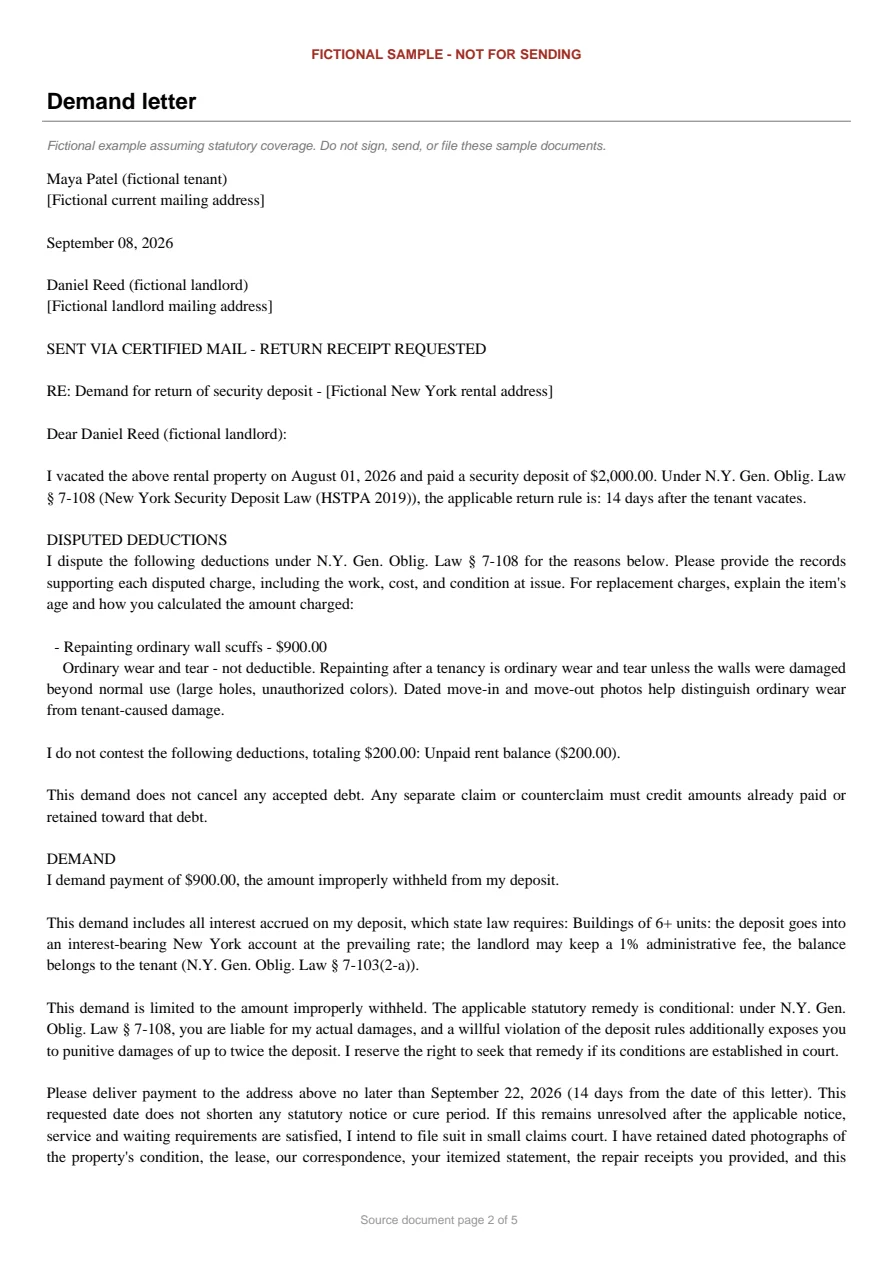
Read the complete New York sample letter
Fictional New York case. Generated sample, not a court outcome or a substitute for your own letter.
Maya Patel (fictional tenant)
[Fictional current mailing address]

September 08, 2026

Daniel Reed (fictional landlord)
[Fictional landlord mailing address]

SENT VIA CERTIFIED MAIL - RETURN RECEIPT REQUESTED

RE: Demand for return of security deposit - [Fictional New York rental address]

Dear Daniel Reed (fictional landlord):

I vacated the above rental property on August 01, 2026 and paid a security deposit of $2,000.00. Under N.Y. Gen. Oblig. Law § 7-108 (New York Security Deposit Law (HSTPA 2019)), the applicable return rule is: 14 days after the tenant vacates.

DISPUTED DEDUCTIONS
I dispute the following deductions under N.Y. Gen. Oblig. Law § 7-108 for the reasons below. Please provide the records supporting each disputed charge, including the work, cost, and condition at issue. For replacement charges, explain the item's age and how you calculated the amount charged:

  • Repainting ordinary wall scuffs - $900.00
    Ordinary wear and tear - not deductible. Repainting after a tenancy is ordinary wear and tear unless the walls were damaged beyond normal use (large holes, unauthorized colors). Dated move-in and move-out photos help distinguish ordinary wear from tenant-caused damage.

I do not contest the following deductions, totaling $200.00: Unpaid rent balance ($200.00).

This demand does not cancel any accepted debt. Any separate claim or counterclaim must credit amounts already paid or retained toward that debt.

DEMAND
I demand payment of $900.00, the amount improperly withheld from my deposit.

This demand includes all interest accrued on my deposit, which state law requires: Buildings of 6+ units: the deposit goes into an interest-bearing New York account at the prevailing rate; the landlord may keep a 1% administrative fee, the balance belongs to the tenant (N.Y. Gen. Oblig. Law § 7-103(2-a)).

This demand is limited to the amount improperly withheld. The applicable statutory remedy is conditional: under N.Y. Gen. Oblig. Law § 7-108, you are liable for my actual damages, and a willful violation of the deposit rules additionally exposes you to punitive damages of up to twice the deposit. I reserve the right to seek that remedy if its conditions are established in court.

Please deliver payment to the address above no later than September 22, 2026 (14 days from the date of this letter). This requested date does not shorten any statutory notice or cure period. If this remains unresolved after the applicable notice, service and waiting requirements are satisfied, I intend to file suit in small claims court. I have retained dated photographs of the property's condition, the lease, our correspondence, your itemized statement, the repair receipts you provided, and this demand letter.

Sincerely,


Maya Patel (fictional tenant)

Enclosures: Evidence exhibit list
Send it with a record you can use.
State the vacating date and identify each disputed deduction. Include the move-out inspection list, any work you completed to cure listed issues and photos showing the final condition.
N.Y. Gen. Oblig. Law § 7-108: return and accounting ↗What happens after sending?
Compare the itemized statement with the permitted deductions and any inspection opportunity. Keep any repair receipts you requested, without treating them as a universal attachment requirement.
They refund some or all of it
Save the payment record and update what remains disputed. Read any settlement or release before agreeing to it.
They reject the request or explain the deductions
Match each explanation to your lease and condition records. Reply with the specific amounts and reasons still disputed.
The letter comes back or nobody responds
Keep the envelope or tracking record. Check the address and required service method before using the New York filing guide. Attempted delivery may not complete statutory service.
Frequently asked questions
Which return deadline should my New York letter refer to?
14 days after the tenant vacates. Failure to provide the deposit and itemized statement within 14 days means the landlord forfeits any right to retain any portion of the deposit.
What penalties does New York law allow if the withholding was wrongful?
A landlord who violates the deposit rules is liable for actual damages; a willful violation additionally carries punitive damages of up to twice the deposit (N.Y. Gen. Oblig. Law § 7-108).
What happens if the landlord ignores the letter?
You can file in small claims court (limit: $10,000 in NYC; $5,000 in City Courts and Nassau/western Suffolk District Courts; $3,000 in Town/Village Courts; filing fees $10-$20 depending on the court and claim amount). Check required notices, filing deadlines and the court's rules before filing.
New York filing steps and court forms →