Landlord kept your deposit in Ohio? Find your next step.
No refund, only part of your money back, or charges you disagree with? Start with what you received, then build a response using your records and Ohio law.
Analysis free · Full case package $29-$49, one time · mailing optional
The deadline check is optional. See what you get
What do you need help with?
Open the situation that fits. Each route gives you something to check, something to keep, and a next step.
I received nothingNo refund and no list of deductions.
Check the trigger, then the date. 30 days after termination of the rental agreement and delivery of possession; the tenant must provide a forwarding address in writing to preserve the damages and fee remedies.
Keep: your deposit payment, move-out or key-return record, forwarding-address notice and any earlier written request. These establish the timeline behind your demand.
Analyze my missing refund - free →I received part of my depositSome money came back. Find out what explains the difference.
Reconcile the refund. Compare the original deposit, what was returned and each deduction. Separate charges you accept from charges you dispute.
Check the amount they kept - free →Enter the refund and deductions in the case builder. You do not need a separate worksheet first.
The Ohio accounting rule: Any deduction must be itemized and identified in a written notice delivered with the balance due within 30 days (R.C. 5321.16(B)); vague entries like 'cleaning fees' are too general per Ohio Legal Help.
Check interest too. For a tenancy of at least six months, the deposit portion exceeding the greater of $50 or one month's periodic rent earns 5% annual interest, payable annually (R.C. 5321.16(A)).
Keep: the refund record, deduction list and notice envelope or delivery record. If money is still unexplained, identify that gap in your written request.
I disagree with the deductionsYou have a charge list, whether or not a refund arrived.
Respond to the specific charges. Note each amount, why you dispute it, and which photo, message or record supports your position. Check the notice instructions above before choosing how and when to reply.
Check my deductions - free →The records rule in Ohio: The statute requires an itemized written notice identifying each deduction; the landlord bears the burden of justifying deductions as unpaid rent or damages from the tenant's noncompliance.
No move-in photos? Use an inventory checklist, inspection report, dated repair request, messages or witness accounts to explain the condition.
I already sent a demandThe landlord has not paid, or the dispute is still unresolved.
Compare the written notice with the refund and your evidence. A missing forwarding address affects the statutory remedies differently from the underlying right to money due.
See the Ohio court route →Keep: your sent demand, delivery record and any reply. Use the court guide to check where to file, which forms to use, and the filing and service costs.
Turn the dispute into a documented demand
- Free: understand your dispute
- Add your refund, charges and records. Get a charge-by-charge analysis of the deposit rules and potential remedies under Ohio Rev. Code § 5321.16.
- Optional: your case documents, $29-$49
- Your demand letter, damages summary and evidence checklist, ready to review and send with your records. Mailing is optional and costs extra.
One charge, backed by a reason and records
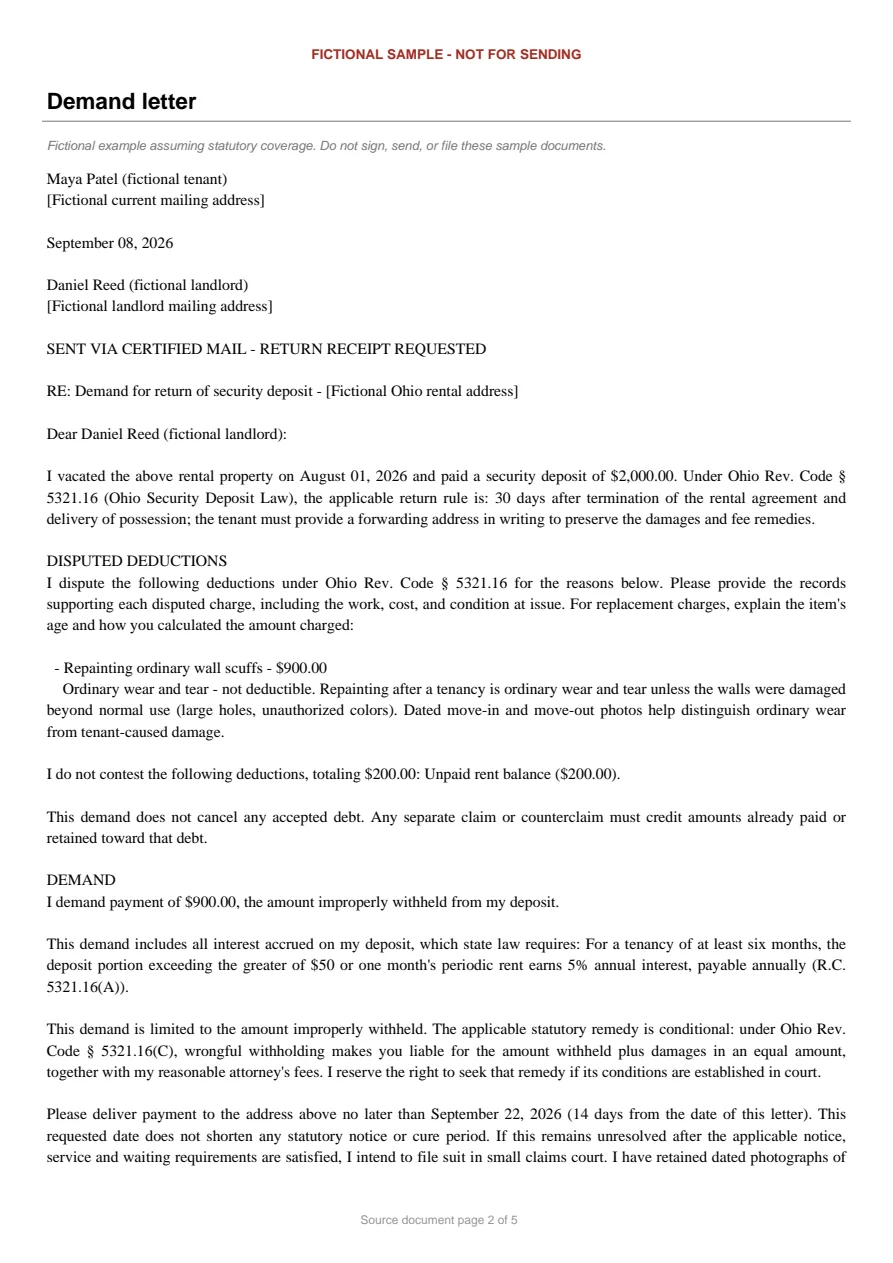
Fictional Ohio example. Assumes coverage under the cited law; not a customer outcome.
- The charge
- Repainting ordinary wall scuffs: $900
- Records to attach
- move-in photos and move-out photos
 Open PDF ↗
In the generated letter
Ordinary wear and tear - not deductible. Repainting after a tenancy is ordinary wear and tear unless the walls were damaged beyond normal use (large holes, unauthorized colors). Dated move-in and move-out photos help distinguish ordinary wear from tenant-caused damage.
Prefer to write it yourself? Use the free Ohio letter template.
Before you call the refund late
30 days after termination of the rental agreement and delivery of possession; the tenant must provide a forwarding address in writing to preserve the damages and fee remedies.
Ohio Rev. Code § 5321.16 ↗Deposit statute reviewed August 2026. Review dates refer to the cited rules.
Check the return timeline
Optional date estimate. Read the start conditions above; a passed date alone does not establish a violation. Your date and deposit amount carry into the free analysis.
Already know the dates? Go straight to the refund and charges.
Continue to my free analysis →Questions before your next step
What should I do first if my landlord kept my deposit in Ohio?
Check the statutory deadline. 30 days after termination of the rental agreement and delivery of possession; the tenant must provide a forwarding address in writing to preserve the damages and fee remedies. Save your move-out records, any refund and the itemized statement. Compare them with the deadline and deduction rules below.
Do I need a lawyer to get my deposit back in Ohio?
You can write a demand yourself. If you consider a court claim, small claims court (limit: $6,000) is designed for self-represented tenants - filing fees run about $30-$85 depending on court.
What happens if my landlord doesn't return my security deposit in 30 days in Ohio?
Amounts kept without a timely itemized notice become wrongfully withheld - recoverable with statutory damages and attorney fees under R.C. 5321.16(C).
Am I owed interest on my deposit in Ohio?
In at least some cases, yes. For a tenancy of at least six months, the deposit portion exceeding the greater of $50 or one month's periodic rent earns 5% annual interest, payable annually (R.C. 5321.16(A)).
What can I ask to recover in a Ohio deposit dispute?
The tenant may recover the amount wrongfully withheld plus damages equal to that amount (i.e., double) and reasonable attorney's fees (R.C. 5321.16(C)) - if a written forwarding address was provided.
Read the full Ohio deposit-law guide for the return, deduction and remedy rules.